
Elevated Embroidery: Beading the Sunset Skyline

“One can’t paint New York as it is, but rather as it is felt.” - Georgia O’Keefe

While working in luxury fashion, I was so fortunate to spend several years living in Manhattan. The incredible sunsets outside my window gave me fabulous inspiration for colors and textures! The textural beaded choker in this article was designed and worn to a friend’s New York Fashion Week show, and was created to share my vision of the New York City skyline with all of my designer friends.
Choker-style neckpieces have adorned necks for centuries, gracing everything from royal portraits to modern runways. This dimensional beaded design, inspired by the geometry and grandeur of Manhattan skyscrapers, brings an architectural edge to the soft elegance of ribbon and glass beading. Beaded lines, metallic reflections, and structured symmetry echo the upward ambition of urban skylines. The small scale of this ribbon necklace also allows you to play with time-intense techniques at a micro scale, and then wear your beautiful swatch! Chokers have a long and beautiful history; making one yourself is not just a fashion project, but a small act of wearable art that connects past to present.

The Trends
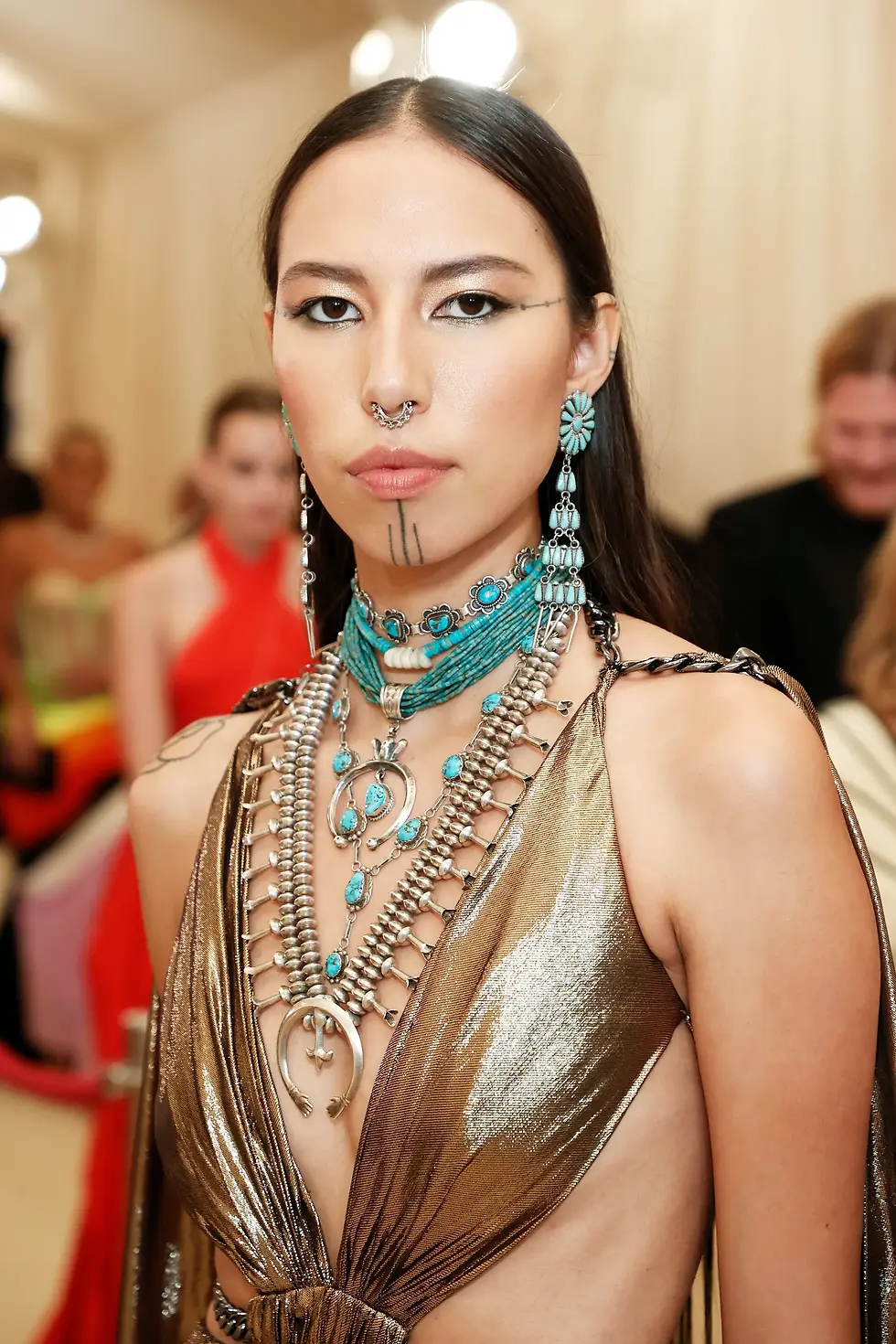
Chokers and close-fitting neckpieces date back to ancient civilizations. In Ancient Egypt, high-status individuals wore close-fitting neckpieces painstakingly crafted from gold and lapis. In Native American cultures, bone and beaded chokers held ceremonial and symbolic power. The Victorian era brought chokers into European fashion, with women sporting luxurious velvet ribbon bands embellished with cameos or pearls, often worn by royalty and upper-class women. In these historic examples, the Choker was a high-fashion, highly-respected style, an elevated symbol of hierarchy and belief. Dimensional beadwork, often seen on these luxurious pieces, has deep roots in global textile traditions, from Eastern European bead embroidery to the Huichol people’s intricate peyote stitch in Mexico, a technique which involves creating raised surfaces or layered effects with beads sewn directly onto fabric or thread foundations. Many of these traditions have their own unique materials and stitch structures; the techniques to make these pieces can be very methodical.
The Design
Like any architectural project, good planning is key to success in your dimensional beading. Sketch your layout first—will your beaded skyline have symmetrical towers, staggered heights, or a central focal point? Use lined paper or graph paper to map out your "urban grid." Measure your neck, add 2 inches to the ribbon length for ease, and then add as much ribbon as you like to trail down the back… a long tail or bow can look very romantic!. Shopping for the beautiful ribbon, threads and beads in the Manhattan Garment District was such a fun part of this project!
Before diving into your city-inspired choker, here are some essential supplies:

Petersham Ribbon: Superior to Grosgrain for this application, due to the ability to stretch and be steamed to the shape of the neck. A high-quality ribbon about .5” to 1.5” wide. I’ve used a 1.5” Rayon Petersham from Shindo, in 2 soft blues to imitate the sky.
Beads: Choose Miyuki seed beads, long glass bugle beads (ideal for vertical, tower-like lines), pearls, glass cubes, or crystals to mimic glass and steel. I used some brighter colors to look like sunset off of the buildings in Manhattan, as well as some beautiful transparent Swarovski crystals to look like glass!

Threads: You will need a variety of threads. Here, I’ve used a standard DMC cotton (split) and Sajou waxed cottons in complementary colors for the beading, and a clear quilting nylon to marry the 2 colors of ribbon and hide the inner stitching.
Needles: Size 9 beading needles are perfect for maneuvering through small or multi-pass beadwork (and I chose to do my finishing with this as well!) You may need a slightly longer needle for some of the dimensional work, depending on the length of your bugle beads.
Twill-wrapped or well-sanded wooden embroidery Hoop: An embroidery hoop wrapped in cotton twill or sanded to prevent pulls will protect your delicate ribbon. It is not necessary to hoop the choker too tightly!
The Build
Next, cut your facing ribbon to the desired measured length. Set aside your backing ribbon for later. Place the facing ribbon in an embroidery hoop, firmly, but not stretched. Now for the fun! When creating dimensional beading, play around with different heights and combinations of beads. In such a small area, it’s fun to go wild and be experimental! Remember, cities are constantly changing and growing… It’s ok if your embroidery evolves as you go. You can use architectural motifs to give your choker that elevated feel: vertical bugle beads for tower forms, stacked seed beads to mimic layered bricks or beams, and crystals to represent reflective “windows”. In my case, I worked symmetrically from my first stripes, keeping in mind where I wanted my center textures to fall. I also used pins to mark the various embroidery sections, so that I would be sure to have the sculptural embroidery in the center and make sure the beading did not extend into the area for knotting at the back neck. Maintain thread tension to keep lines crisp and dimensional; avoid sagging or pulling too tightly, which can warp your petersham and create ripples in the ribbon. The straight lines of the Petersham helped guide the gridded layout I was aiming for.

As you add more layers, consider how height and light interact. Taller bead stacks can give your choker architectural depth. Shiny beads catch the light like glass panels, while matte finishes offer grounding.

To create a “skyline silhouette,” vary bead height across the length—taller at center, tapering toward ends. Tiny clusters can create visual interest, and I even experimented with some 3D “bridge” forms!. For dramatic effect, you can even try vertical drops of fringe coming down from the edge of your ribbon.
Finishing Touches

Once your skyline is fully realized, carefully remove the ribbon from the hoop. Inspect your work: all beads should be securely attached, and the ribbon free from puckers. You can conceal the back of your beading with your second ribbon—simply stitch the edges of your ribbons together using a prick stitch. You can decide how much ribbon you want to match on the back and how much you want to leave free; I only backed the part that touches my neck. I keep the running nylon thread between the ribbon layers

to ensure it's extra invisible! To finish the ends of your ribbons, fold the petersham twice over (about .5” fold) and stitch it down neatly. Test the fit, ensuring that the choker sits comfortably and flat against your neck. Your choker can be lightly steamed into shape, but be cautious not to melt any plastic beads or sequins. Once pressed, the Petersham should hold shape well and conform to the curve of the throat.
Now, time to create a skyline embroidery of your own! Take pictures of your view at sunset, and see how you can create a beautiful beaded expression of the world around you.
Finished your skyline embroidery? Post it in the community — we can’t wait to see your take!


