
CAVANDOLI TECHNIQUE
Introduction
As it happened for Bricco embroidery, I discovered this technique by chance. I’ve found a very small piece of Cavandoli in a bric à brac market. It attired my attention, since I’d never seen such a work before. Once at home, I start to study it as working technique and contemporarily I tried to find some information about it on old embroidery manuals. I found that it was known as “Cavandoli” from the name of the lady who started a real production with it. The story is not a common commercial production one, but a deep human help story.
About
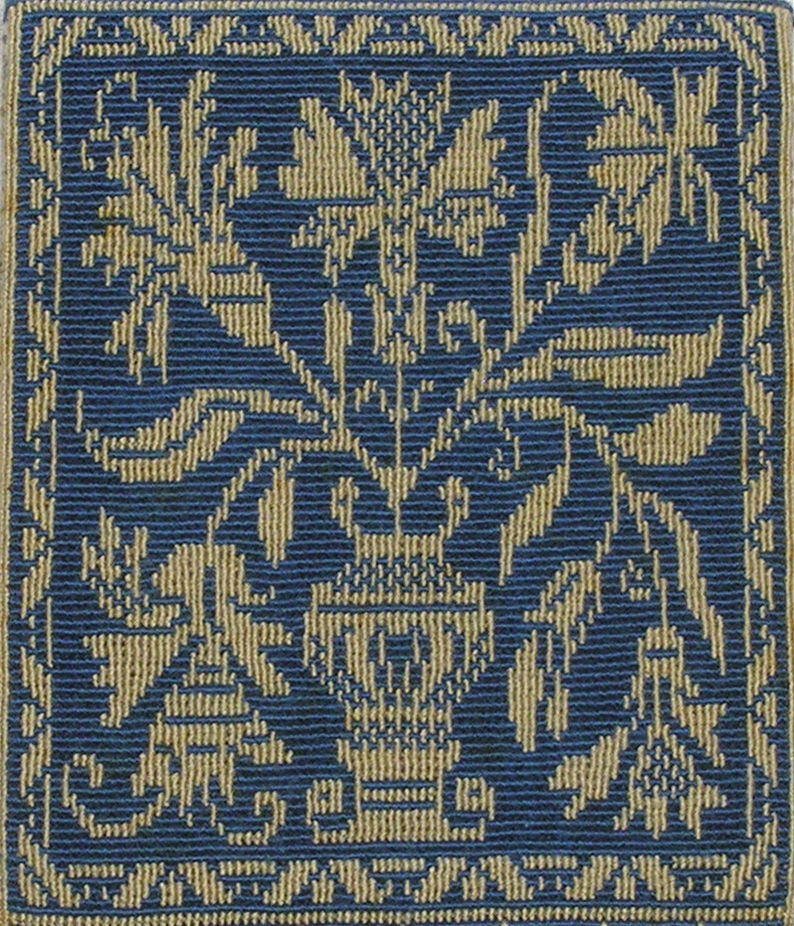
Cavandoli is a technique derived from macramé. Its work involves the use of two threads of contrasting colours and two knots: horizontal knots are made with the background colours, while vertical knots are made with the subject colours. This results in a two-tone, compact and sturdy fabric with a double right side. The "Cavandoli" technique can be used to make belts, needle holders, scissor cases, bookmarks, book covers, borders, tablecloths, towels, bibs, handbags, eyeglass cases, box and cushion decorations, work bags, centerpieces, chair headboards, watch straps, key rings, bottle coasters, and coasters.
Name origin
Name is due to Valentina Cavandoli, a very clever woman who, with her help to families and children, made a difference in the place where she lived. It is a very interesting story.
History
Valentina Cavandoli, born in Reggio Emilia on April 11, 1872, descended from a family of Risorgimento patriots. She spent her childhood and adolescence in various Italian cities and in Argentina, finally settling in Turin. She earned her teacher training diploma and subsequently demonstrated great talent for teaching and studying pedagogy and child psychology, leading her to be appointed Director of a major Turin institute and to pursue studies under the great educator Maria Montessori.

On 1915, the outbreak of the First World War brought about a social upheaval paralleling the war itself: the departure of most men for the front, especially in the countryside, forced women to replace husbands, fathers, and brothers in agricultural work. This new social situation, combined with the war and the diseases that were taking their toll everywhere, left countless children alone and without care.
A group of volunteers from Turin committed themselves to finding these children and, with the consent of their families (who, sad to say, were happy to be free of so many mouths to feed), to transfer them to several villas in Turin to care for them. The management of one of these villas was entrusted to Valentina Cavandoli. The volunteers and their caregivers, with more than 1,500 children hospitalized, quickly realized the precarious conditions of their young guests. Exposed to tuberculosis at home, they arrived at the villas frail and weak. After a period spent in healthy homes, the children's health improved. In 1918, at the end of the world war, the volunteers decided to continue the experience, dedicating
themselves to caring for healthy children of parents suffering from tuberculosis. Thus, after various temporary placements, in 1921 they were able to permanently settle in Villa Giorgina Levi (later called Casa del Sole) at Via Valgioie 10 in Turin. The villa was donated by industrialist Donato Levi in memory of his seventeen-year-old daughter, who died of tuberculosis in 1920. The institution's maintenance was guaranteed by grants from several wealthy families: Valentina Cavandoli was appointed as director. The house was renovated and equipped with amenities uncommon for the time, such as dormitories, dining halls, and showers.
Valentina's socio-pedagogical-teaching method was extremely innovative for its time and proved particularly effective for the children's well-being and education.
Boys (aged 3 to 12) and girls (aged 3 to 15) came from families characterized by poverty, neglect, indigence and violence, and were therefore uneducated, dirty, aggressive, violent, and rude. With love, patience, and skill, Valentina quickly earned the trust of each child and highlighted their aptitudes, feelings and abilities, gaining their cooperation.
The boys and girls attended the neighbourhood public schools, which provided them with a basic education. They also learned personal hygiene and how to perform all types of household chores, regardless of their gender, because Valentina believed that every human being should be able to manage at any time and in any situation. As for play, they practiced reading, acting, music, and a manual activity Valentina had learned from her great-grandmother, which Elisa Ricci, an Italian historian of embroidery and lace, later named Cavandoli.

It was a craft suitable for both boys and girls, and besides being enjoyable to do, it was also educational because it required clean hands to avoid dirtying the threads, which were knotted directly without the aid of accessories. It also required attention and precision in counting the threads and knots to avoid misinterpreting the patterns.
The works created at the Casa del Sole were sold at seasonal markets, and the proceeds were deposited into the savings account Valentina opened at the bank for each young guest. At the end of their stay at the Villa, before joining the family Valentina had found for them, who would provide them with a decent home and a decent working life, the children could withdraw the money they earned. This custom also demonstrates Valentina's honesty and her ability to think ahead of the social norms of her time.
With the advent of the racial laws and the outbreak of World War II, Casa del Sole, which relied primarily on funding from families belonging to the Jewish community, was forced to cease operations, never to be resumed.
Valentina, who received the "Gold Medal of Merit for Public Education" in November 1961, lived for decades with the families of former students and died on February 7, 1969, at the age of 97.
Spread to other countries
I’ve no information about working of Cavandoli in other countries, but as always, I hope that somebody can learn from me and spread it anywhere.
Type of stitches
It’s worked with knots similar to macramé, but with a horizontal and vertical knots which follows a scheme with squares, forming filled figures and designs.

Style of patterns
Any cross stitch or filet scheme can be used to work with Cavandoli. Figures will be formed using the knots in rows for each square of the scheme.
The care it requires for counting, joined with the movement of the hands, performs a very relaxing moment for the mind.
Regarding materials and equipment, you will need:
• a slightly firm cushion or pillowcase to secure the threads and knots
• pins to secure the threads
• scissors to cut the needles
• twisted, not too stiff yarn, e.g., PERLE' No. 8 (threads with a loose twist fray easily and lose their lustre; stiff yarns are less malleable and prevent precise knotting)
• filet or two-colours cross-stitch square patterns
Nowadays
Cavandoli is still not well known. No other books except mine have been written after 2007 and, even though some Italian people work with it following the instructions in my manual, it is not as widespread as other techniques derived from macramé.
Conclusion
As with Bricco Embroidery, I can say with great satisfaction that the rediscovery of this technique is the result of my own extensive personal research, which yielded no results for 10 years. Then, almost miraculously, my tenacity was rewarded and the story of Cavandoli was revealed to me.
The small piece I’ve tried and copied from the original one found in the market, was noted by the cousin’s wife of Valentina at the end of an exhibition, while I was already dismantling my stand.
It was not my intention to bring it at the exhibition, being still on the study step. I was hundred per cent sure not to have brought it, but when mounting the stand, I’ve found it on the bottom of the box, so I hanged it on the wall anyway. Nobody asked me any information about it for three days long. It was completely invisible to the public. Less than half an hour to the closure, Mr. Guaschino and his wife passed in front of my stand, and the piece caught their eye. In Piedmont language they said “Is it not the one of Valentina?” It gave me a thrill! They both known very well what it was! From that moment on, the story was revealed.
I would like to thank General Gherardo Guaschino and Dr. Secondo Guaschino, cousins of Valentina Cavandoli, and their wives, Mrs. Isa and Mrs. Maria Luisa, as well as Mrs. Maria Durione (Valentina's former student and assistant) and her daughter Silvia Maffei for their invaluable collaboration.
My book, "Bricco and Cavandoli: Two Needlepoint Tales," written to prevent Bricco Embroidery and Cavandoli from falling into oblivion forever, contains the history, technique, materials, and drawings needed to understand and reproduce these two techniques, part of the immense world of Thread Arts.
References:
Gisella Tamagno “Bricco e Cavandoli, due favole in punta d’ago” – self publisher, Turin – Italy 2007
Various authors, “Manuale del cucito e del Ricamo” publisher Cucirini Cantoni Coats, Milan
Lucia Petrali Castaldi, “L’opre leggiadre – I lavori femminili nelle regioni italiane” publisher Antonio Vallardi, Milan Italy - 1940
Paola Carrara Lombroso “Casa del Sole – un esperimento educativo sui bambini del popolo” extrait of bulletin “Maternité et enfance” year II nr. 9 – published by Stabilimento Tipografico Riccardo Garroni, Rome 1927 and Officina Tipografica Elzevirana, Turin 1925
Elisa Ricci, “Ricami Italiani antichi e moderni” publisher Felice Le Monnier, Florence – Italy 1995
Various authors, “Mani d’oro” published by Fratelli Fabbri, 1966


