
The Hidden Meanings of Mexican Embroidery

Growing up in a Mexican household, I always knew that embroidery held a special place in Mexican fashion. I grew up seeing embroidery on traditional China Poblana dresses during Mexico’s Independence Day celebrations. As I shared in my last article, my Muñeca Pituka doll from Puebla, Mexico, was one of my earliest inspirations. Her China Poblana outfit, which featured machine-stitched floral patterns embroidered with thick, textured thread against black fabric, helped me realize how vital embroidery is even within doll fashion. But embroidery in Mexican fashion goes beyond just dolls and women's fashion; at my aunt’s house, I noticed how embroidery also appeared on everyday household items like tablecloths. Now, as an adult, whenever I think of Mexican embroidery, I think of floral motifs and colors such as black, white, yellow, pink, and blue. While these colors and motifs are very common, they also carry deep historical significance, preserving pre-Hispanic symbolism that survived colonization. Furthermore, Mexican embroidery is far from monolithic; it can change dramatically from region to region. Yet as these traditions face the pressures of global fashion and the risk of fading away with older generations, understanding their true origins becomes all the more essential.

Mexican embroidery dates back to the ancient Maya civilization, more specifically in the state now known as Campeche. In Campeche, Maya artisans embroidered a garment called a Campeche-style huipil, a square-necked blouse with a hand-stitched design featuring black embroidery along the collar and sleeves. The embroidery is stitched onto white linen. These designs traditionally depicted squash flowers, onions, colonial ships, and scenes of the city, serving as proud expressions of identity, territory, and womanhood. Today, the Campeche-style huipil remains a cultural staple despite centuries of Spanish and French influence. Another tradition that has remained consistent is the production of natural dyes by artisans. Artisans use natural dyes derived directly from local flora, such as the muicle bush to produce rich purple and blue hues. Similarly, Otomí embroidery, which comes from the Otomí people in central Mexico, is still used today in regions such as Tenango de Doria, Hidalgo, and elsewhere in the altiplano. Inspired by ancient cave paintings, Otomí embroidery originally featured animal silhouettes, later expanding to include natural, supernatural, and abstract geometric motifs. Artisans preserve pre-Hispanic techniques by hand-drawing each design, layering narrow herringbone stitches, and densely packing thread to fill shapes. These vibrant pieces, known as tenangos, are stitched on white cotton or wool, though modern artisans sometimes integrate synthetic fibers. Though many techniques have pre-Hispanic roots, some techniques were introduced into Mexican embroidery after Spanish and French influence, such as:
The cross-stitch technique: First used on dresses but later on blouses, huipiles, zarapes, accessories, and home décor. In the Huasteca region, the Tének people adapted cross-stitch to express their unique mythology.
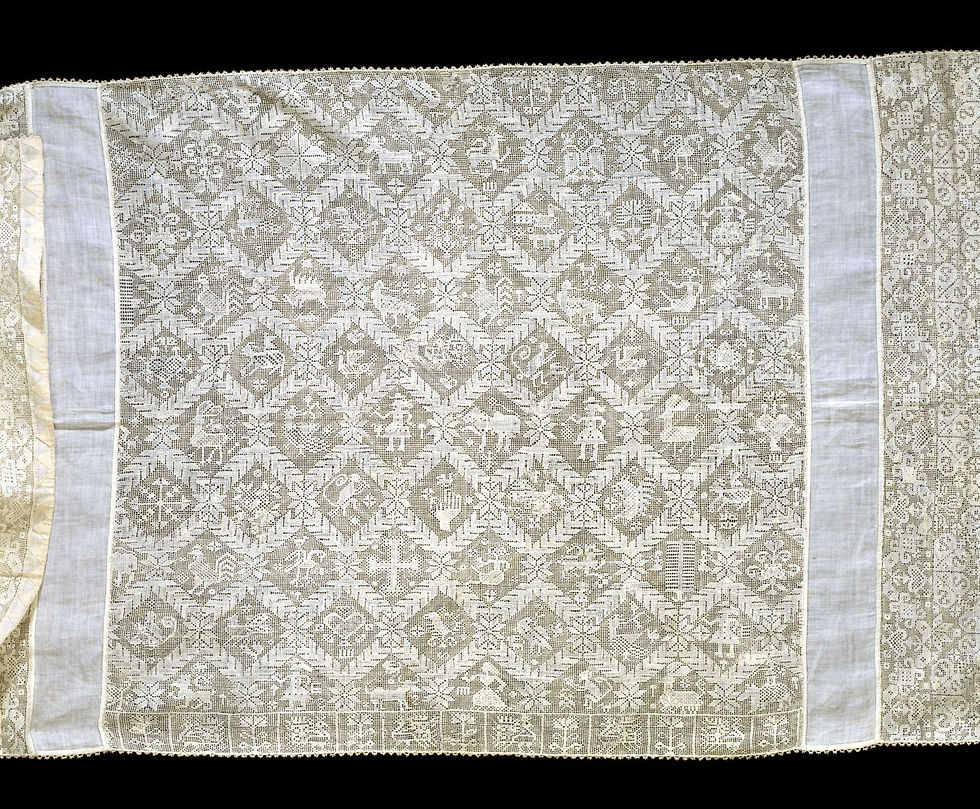
Whitework: Popularized more by the Spanish, whitework involves stitching white thread onto white linen foundation fabric, which is later combined with deshilado (drawn threadwork), and allows artisans to create detailed scenes of spider monkeys, mermaids, women in wide skirts, birds, flowers, sacred hearts, and crosses.

Glass beads: Also influenced by Spanish traditions, glass beads quickly became popular for decorating samplers, napkins, and costume trimmings with shimmering floral lines and fauna.
Rebozo: A mix of Spanish, Asian, and Indigenous influences, the rebozo is a long woven garment made of cotton, wool, silk, or rayon. Finished with intricate, hand-knotted fringe, it remains a versatile shawl and baby carrier for Indigenous and Mestiza women alike.
Though, as stated before, Campeche, Tenango de Doria, Hidalgo, and the altiplano still use pre-Hispanic embroidery, there are other places that represent the diversity in Mexican embroidery, such as central and eastern Mexico, Oaxaca, and Coahuila. Examples include:
Central and eastern Mexico: The garment quechquemitl, which has existed since the Mesoamerican era, still uses traditional Mesoamerican designs to honor Tének heritage and is mainly worn by Indigenous women.
Oaxaca: Tehuana garments feature bold floral designs on velvet or satin using gancho (hook) chain stitches and natural dyes like cochineal (cochinilla). Huipiles use life cycles, spring blossoms, and ceremonial identity (worn for weddings or burials).
Huautla de Jiménez uses cross-stitched floral motifs accented with pink and blue ribbons. The ribbons represent flora and the sky and symbolize spring and renewal.
Saltillo, Coahuila: The sarape is a rectangular woven shawl or blanket with vivid, repeating color stripes that are used for regional identity and protection against the elements.
Each color, textile, and design changes based on region; however, it only showcases how Mexican embroidery tends to change with each state. Still, there is a lot of meaning behind the colors, patterns, and designs. For instance:
Animals: For the Otomí people, animals such as deer, birds, and armadillos are used to help people form deeper connections to nature or their guardian spirits.
Plants and leaves: Symbolize life, fertility, and a bond with the earth for the Tének community and communities in Tzintzuntzan, Michoacán.
Geometric figures: The Tének community also uses geometric figures to define sacred and protective elements in Indigenous cosmology, such as visions of the passage of time and life.
Community Storytelling: Communities in Tzintzuntzan, Michoacán also use embroidered textiles, as they serve as visual historical records of community events, wildlife, and local lore.
However, these sacred arts face serious threats. For example, one technique called Xmanikté is at risk of being lost due to declining contact with elders who hold this knowledge. Similarly, within the Tének community, fewer young women are learning traditional cross-stitch as older generations pass away. Still, there is hope as mothers are archiving their patterns for their daughters, while communities like Cuetzalan, Puebla, have established workshops to teach younger generations traditional stitching. Yet many embroidery methods change once they enter global fashion. For instance, when international brands like Zara or luxury fashion houses like Carolina Herrera copy Otomí or Mixtec embroidery, the sacred context is completely lost. What once took a master artisan weeks to hand-stitch with sacred intention becomes a mass-produced "boho print" printed on polyester. Not only does this strip away the spiritual storytelling embedded in every stitch, but it also deprives Indigenous communities of fair credit and economic survival. Fortunately, initiatives like Mexico’s ORIGINAL movement and regional artisan co-ops are fighting back, demanding fair compensation, intellectual property recognition, and respect for cultural heritage.

Mexican embroidery is more than just a trend; it is a living, breathing history book woven by generations of women. As consumers and admirers of fashion, recognizing the hidden meanings behind these garments is the first step toward making sure these ancient traditions never fade away.
Ultimately, Mexican embroidery is far more than a decorative detail or a passing fashion trend; it’s a living archive of resilience, identity, and storytelling. From the hand-stitched floral patterns on my Muñeca Pituka doll to the centuries-old pre-Hispanic cosmovision preserved in Oaxacan and Otomí textiles, every stitch carries a purpose. Though Spanish colonization, modern fast fashion, and the aging of master artisans have threatened these traditions, the craft continues to endure. As younger generations, artisan co-ops, and cultural preservation efforts work to protect these sacred techniques, we are reminded of what makes this art form so vital. Honoring Mexican embroidery means looking beyond the surface colors and motifs to recognize, respect, and keep alive the deep history woven into every single thread.
Bibliography
Craft and Travel. “Learning Traditional Mexican Gancho Embroidery from the Istmo of Tehuantepec, Oaxaca, Mexico.” Craft and Travel, July 2022. https://craftandtravel.com/learning-traditional-mexican-gancho-embroidery-from-the-istmo-of-tehuantepec-oaxaca-mexico/.
The Embroiderers’ Guild of America. “Embroidery Techniques from Around the World: Otomi.” EGA Blog, November 2021. https://egausa.org/embroidery-techniques-from-around-the-world-otomi/.
Ha, Lanna. “The Symbolism of Colors in Mexican Otomi Embroidery.” Lanna Ha Blog, May 2024. https://lannaha.com/blogs/news/the-symbolism-of-colors-in-mexican-otomi-embroidery.
Instituto Nacional de los Pueblos Indígenas. “El Huipil, una prenda tradicional indígena.” Gobierno de México, March 2018. https://www.gob.mx/inpi/articulos/el-huipil-una-prenda-tradicional-indigena.
Instituto Nacional de los Pueblos Indígenas. “Libro para descargar: Iconografía Tének de origen ancestral. El significado de los bordados (Bilingüe Español - Tének).” Gobierno de México, August 2020. https://www.gob.mx/inpi/articulos/libro-para-descargar-iconografia-tenek-de-origen-ancestral-el-significado-de-los-bordados-bilingue-espanol-tenek.
Makpalli. “The Legacy of Mexican Embroidery: History, Techniques, and Cultural Importance.” Makpalli Blog, July 2023. https://makpalli.com.mx/en/blog/legacy-mexican-embroidery/.
Museo de Arte Popular. “Hidden Messages in Mexican Textiles.” Google Arts & Culture. Accessed August 24, 2026. https://artsandculture.google.com/story/hidden-messages-in-mexican-textiles/rAXhsRmk7SYOgw?hl=en.
Piece Collectors. “Textiles of Oaxaca.” Piece Collectors Blog, August 2023. https://www.piececollectors.com/blog/textiles-of-oaxaca.
University of Fashion. “Threads of Tradition: Honoring Hispanic Heritage Through Textiles & Embroidery.” University of Fashion Blog, September 2023. https://www.universityoffashion.com/blog/threads-of-tradition-honoring-hispanic-heritage-through-textiles-embroidery/.
Victoria and Albert Museum. “Mexican Embroidery.” Victoria and Albert Museum. Accessed August 24, 2026. https://www.vam.ac.uk/articles/mexican-embroidery.


