
5 Samplers that Will Make You Rethink the Category
The word “sampler” evokes a certain image in many stitchers’ minds: a cross-stitch composition worked on off-white linen, with the alphabet, the embroiderer’s name and a few bands of flowers and other decorative motifs. This is the traditional British or Colonial American decorative banded sampler, named for the neat lines of motifs that march across the fabric. Hundreds of English and Colonial girls and young women made these in the late 1700s and early 1800s.
But samplers come in all shapes and sizes, from traditions around the world. They range from reference works so large they needed to be rolled up for storage to six-inch stuffed models of planet Earth. Read on to learn about five samplers that will expand your understanding of this category.

The Nazca Sampler. The Nazca (or Nasca) Sampler, which was stitched in Peru in the second century BCE. This sampler is more than two feet wide and three feet tall, and it was stitched on cotton using thread from local camelid animals, like the alpaca and vicuña. The colors on this work, which was likely used for reference to recreate designs, remain rich and bright more than two thousand years later. Holbein stitch (also known as double running stitch) in deep red and red and a bright pink are used to create human figures, as well as bird and oversized plants. There are also geometric designs stitched in tent or satin stitch, likely used as borders and to strengthen the edge of garments
The Nazca are the same culture that created the famous Nazca lines that crisscross the deserts of Peru. In addition to thousands of miles of intersecting lines, which may trace waterways, and geometric shapes like triangles and trapezoids, these people also created images of spiders, birds in flight, and other creatures. These shapes are drawn in one continuous, non-intersecting line, making the experience of walking these paths similar to walking a labyrinth.
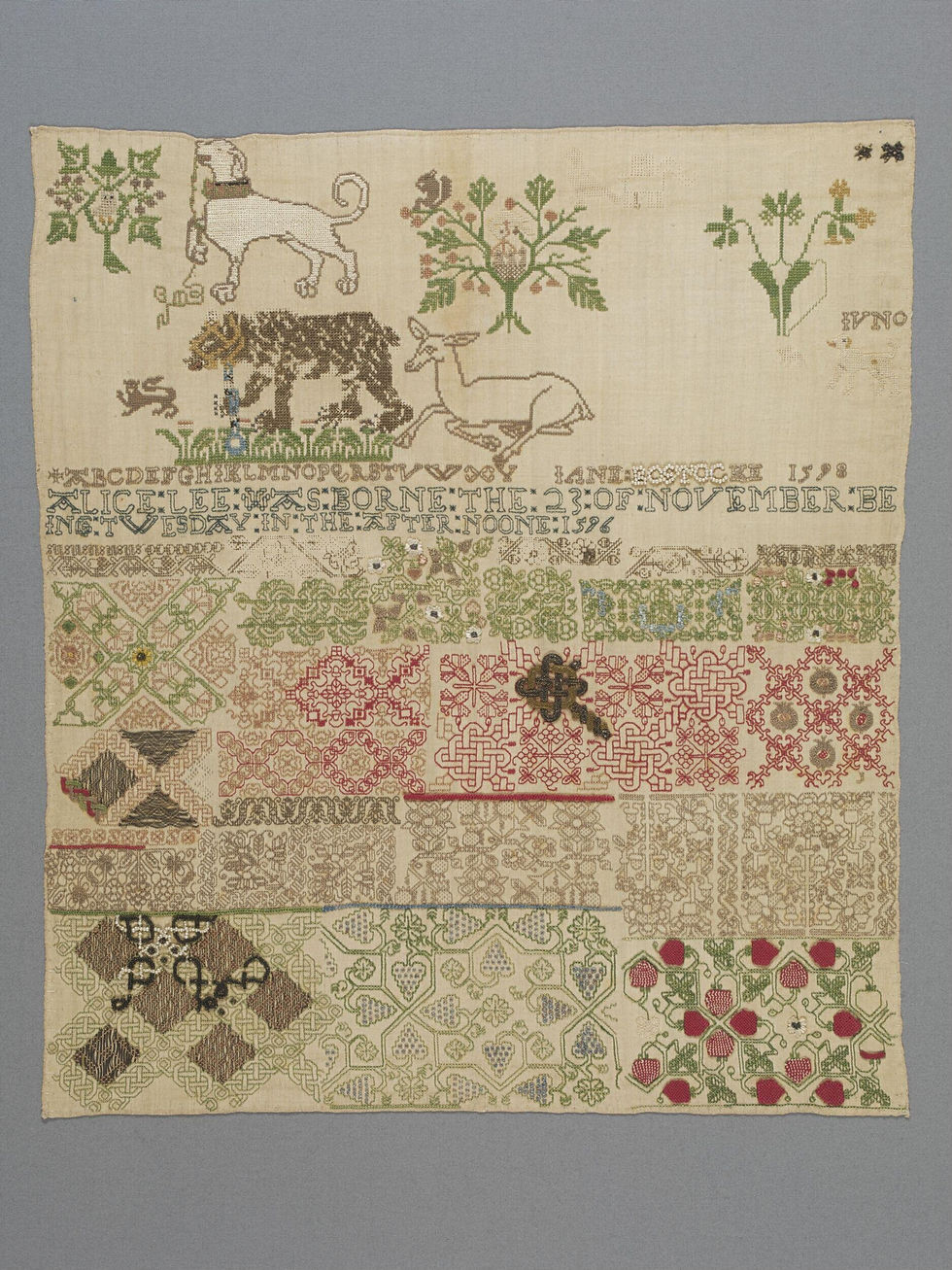
The Jane Bostocke Sampler. The Jane Bostocke Sampler was stitched in England by Jane Bostocke in 1598 using silk thread on linen cloth. Bostocke was the first woman to sign her name to an English sampler. She also stitched a line commemorating the birth of her cousin, Alice Lee, on a Tuesday afternoon in 1596.
Bostocke’s sampler shows obvious skill. It’s covered in rectangular and square patches of repeating patterns that are somewhat organized into lines. While it evokes the traditional image of the British and Colonial American decorative sampler with the stitcher’s name and loose organization, it is also clearly a reference work. Bostocke may have been a professional stitcher who lived with the Lee family and stitched their garments and linens.
Bostocke used Holbein and back stitch (not cross stitch, which became popular later), even to outline her letters. Her decorative motifs evoke modern blackwork, and there is even a border of strawberries. There are images of dogs, as well. Bostocke also decorated her work with tiny beads and pearls, which she used to fill in part of her surname.
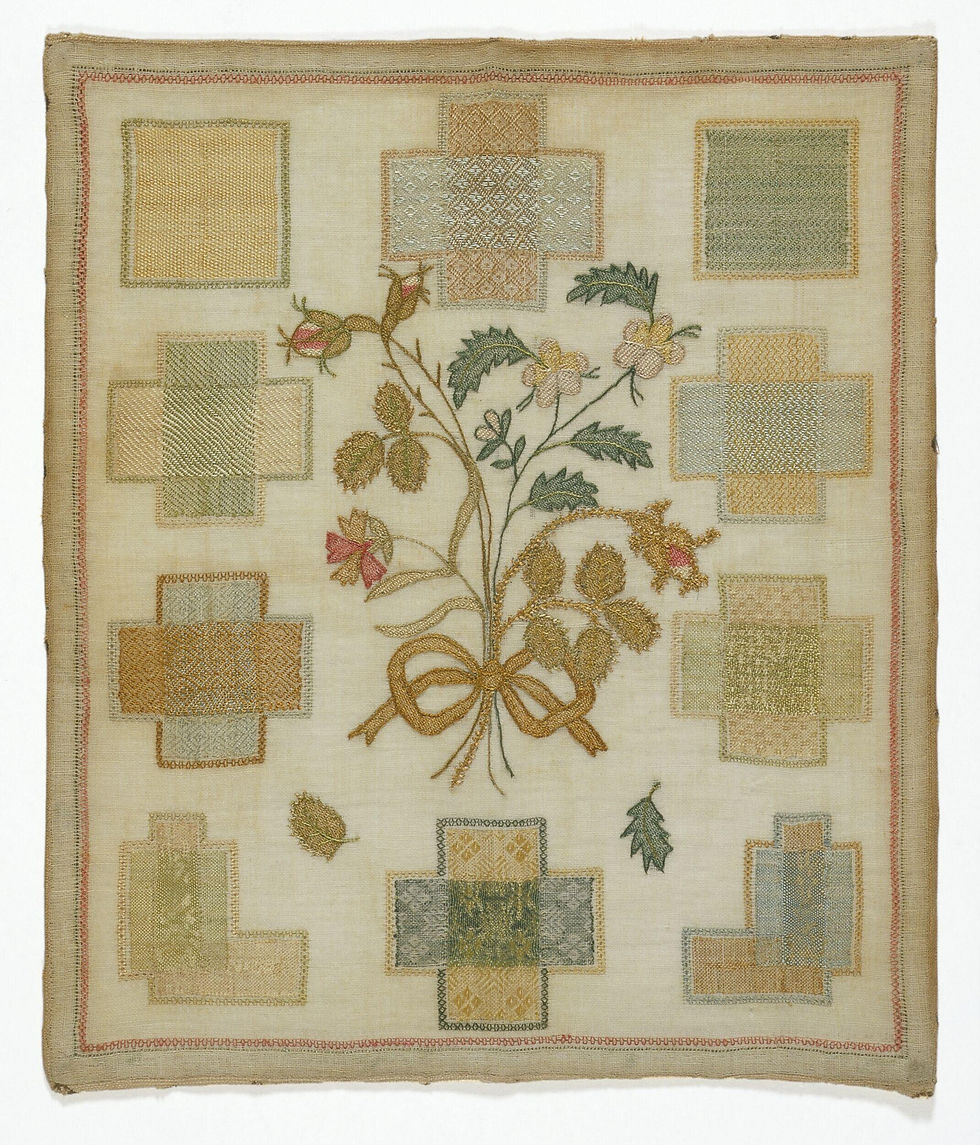
The Decorative Darning Sampler. Darning samplers were made in Belgium and the Netherlands, as well as England and Germany, to show a stitcher’s proficiency in mending and strengthening garments and home linens. Stitched with straight line running stitches that crisscrossed and mimicked the weave of fabric, often on cotton or linen, students progressed from stitching in two colors–which made it easier to spot and correct mistakes–to stitching in one color in both directions.
However, embroiderers who never intended to darn a single item created decorative darning samplers in England in the late 1700s. One held at the Victoria & Albert Museum shows elaborate motifs stitched in darning-style patterns, in multiple colors, and outlined with elaborate stitches. A floral motif in the center is decorated with similar darning-style stitches. Stitched on cotton with rich silk, some in glittering gold, this sampler shows that mending stitches could also be purely decorative.

3-D Planet Earth Samplers. Globes were hard to come by in the early 1800s in America, and students at the Westtown School in West Chester, Pennsylvania, stitched their own. The girls at this Quaker boarding school took a six week course in sewing each year, and while it is unknown exactly how many were required to stitch our planet, 42 globes survive. You can see images of them in this article in The Magazine Antiques.)
These globes were made from linen and silk, stuffed with raw wool, and decorated with pen and ink. Then, each student stitched latitude and longitude lines around the world, as well as the path of the sun, using stem stitch. The level and choice of detail reflect each stitcher’s interests. Five globes that show the constellations in the sky around the world were also made. Each globe is about six inches in diameter.
One student wrote home that she was excited to share her work with her siblings, who would be able to learn geography from it–though she was dismayed by the amount of work the planet sampler required.

The US Citizenship Test Sampler. Aram Han Sifuentes, a modern textile artist who came to the US from South Korea, began stitching the 100 questions of the US Citizenship Test in 2012.
By 2015, she had spent over 230 hours stitching just over half the questions. Sifuentes expanded the project, bringing workshops to museums and schools in Boston, Philadelphia, Chicago, and other places, and inviting other non-citizens to stitch their own Citizenship Test samplers.
Each sampler is for sale on her website for the cost of an application for American citizenship, $760. The full price goes to each stitcher. Each sampler reflects the person’s unique personality and story; each stitcher stitches a single question and signs their name, and they often add patches, stitched images, or even photos to their samplers.
If you’re interested in learning more about these and other samplers, check out Handmade History, Episode 35: Samplers Stitched Around the World.
Bio: Alicia de los Reyes is a freelance writer who loves to make things. She is the creator of Handmade History Podcast, which she co-hosts with her sister Sonia. Find more of her work at aliciadelosreyes.com and handmadehistorypodcast.com.


