

Aari Work
Contents

Coat made of cotton embroidered with coloured silks in aari chainstitch, Gujarat, late 19th - 20th century | Length: 126cm | Victoria & Albert Museum
It is for a reason Ahmedabad is called the Manchestar of India. However, much before the evolution of the textile industry, Ahmedabad gifted India and the world with some of the most astonishing pieces of embroidery work. In fact, calling it a ‘work’ would be saying less about what had been the ultimate epitome of artistry that mesmerized the world for centuries.
Aari embroidery is certainly one of the most renowned and widely exported works. When you look at the breathtaking designs crafted with meticulous details, the dazzling colors, and the subtle delicacy of needlework - you know you are looking at the most exotic assortment.
About
Elegance of Aari Work in India
Aari work was promoted heavily during the Mughal period and the artisans were encouraged to experiment with their craft. It resulted in the invention of a new wing altogether. The Aari work that used to be limited to leather works expanded to clothing as well. The imperial dresses were designed and embellished with Aari work. The tradition has undergone evolution and has embraced modern technology.
Today, the most gorgeous clothes and footwear, designed particularly for gala events, consist of some exhilarating Aari embroidery works. The heritage that took birth in the 12th century, flourished during the Mughal period has now become the torchbearer of Indian embroidery.
Aari Embroidery: A Taste of Royalty
Indian fabric art is often associated with the usage of gold and silver threads, pearls, beads, and sequins. This gives clothes a touch of imperial elegance. Aari artwork, which itself is a delicate craft, combined with exotic designs made of colorful materials becomes distinguished. Aari work is simply a treat to the eyes. Above all, it contains the real essence of hand embroidery which makes Aari so special.
During its days of inception and expansion, Aari designs used to be heavily influenced by nature. The motifs often comprised floral and botanical designs. However, it keeps changing and adapting to the new world.
During British rule, Aari designs accepted European motifs. Today, you can even find geometric patterns, cubes, and other linear designs. Having said that, we must not forget that the true essence of Aari designs has remained the same to date. The beauty of Aari work lies in the master craftsmanship of handmade embroidery. The touch of master artisans makes Aari design imperial items.
History
Birth of Aari: Tracing its Roots and the Story Behind its Name
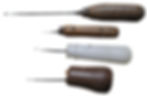
The name ‘Aari’ comes from the needle with which the embroidery work is done. The needle is called ‘Aar’, which refers to a fine small-hooked needle or awl.
As mentioned earlier, aari work began somewhere around the 12th century. A group of leather workers in Western India, specifically in the state of Gujarat invented the extraordinary Aari works. It is quite obvious that the Aari embroidery was primarily restricted to leather works. Shoes and other leather items used to be designed with Aari embroidery.
The art of Aari truly flourished under the patronage of the Mughal emperors. This is when Aari found its way to textile works. Royal dresses used to be stitched with expensive silk threads. The hand embroidery of Aari further enhanced the glaze and glamor of the regal clothesline. During those days, real gold and silver threads would be used to create Aari embroidery designs.
There are multiple instances where we can see the extraordinary design of Aari on royal garments. Some of them even boast of creating incredible landscape designs on the fabric with meticulous details. It goes without saying that the perfection of the master Aari craftsman was beyond question. The Western influence evolved the Aari technique which had been Oriental exotica found its way in the Occidental market as well.
At first, the design is drawn on a thin sheet of transparent paper. Perforations are made along the contour of the design. This is the primary framework of the design. The frame is placed on the fabric and a special powder is sprinkled along the outline of the design. This creates an imprintment of the design on the fabric kept below. After the impression of the outline is taken, the fabric is mounted on a wooden frame where the main work begins.
From royal garments to today’s Indian wear like saree and lehenga, Aari embroidery has remained a staple thus far. The seamless artistry of Aari craftsmen has found appreciation and a sound market in the West.
The influence of Persian embroidery has enhanced it further. The designs of Aari are often based on natural motifs. But why is it so? What makes Aari so different from other embroidery? The history of Aari holds the key to the mysteries. Let us take a plunge inside the mystic world of Aari heritage.
Origins and Cultural Significance
As mentioned before, Aari embroidery was first introduced by the leather workers of Gujarat. The art of Aari was infused with silk and fabric, creating a regal line of Indian wear. However, history has it that the tradition of Aari artwork used to be passed on from one generation to the next generation.
Traditional Learning: It was predominantly male members of a family who used to become the apprentice of a master Aari craftsman. There was no institution to teach Aari embroidery for a long time, as the art was restricted within family lines.
Modern Demand and Expansion: The liberalization of India and the demand of the export market called for massive industrial production. Today, there are many Aari artists throughout India weaving their magic on the fabric.
However, the difficulty of hand stitching and the time taken by Aari embroidery keep many aspiring fashion designers at bay. Those who taste the elixir of Aari alchemy find peace in harmonizing fabric, silk, threads, and beads in the ultimate symphony.
Spread to Other Countries
Evolution of Aari Embroidery
It took Aari embroidery three centuries to bask in the light of glory since its inception. The popularity of early leather work with Aari embroidery was limited within the Western sphere of India. During the Mughal period, the popularity of Aari spread throughout the country.

Mughal Influence: The infusion of clothing and Aari embroidery made it possible. The resplendent avenue of Aari embroidery reached the pinnacle of eminence in the 15th century.
Introduction to the West: Indian embroidery slowly found its way to the Western market in the late 18th century. The European influence refined the Aari designs and made its visual appeal universal.
Mughal Patronage and Growth
The Mughal empire played a key role in bringing Aari embroidery to the limelight that it deserved. It is intriguing how an art form that was created by leather workers went on to become distinguished clothing embroidery.
Chikankari Influence: Embroidery, or as it is often referred to as ‘Chikankari,’ originated in Lucknow. The master artisans of embroidery took inspiration from various sources.
Persian Inspirations: In the first phase of the Mughal empire, embroidery work was heavily influenced by the Middle-East. The fashion sense of the Persian nobles played the catalyst.
Royal Patronage: However, the indigenous artwork of Aari was embraced by emperors such as Jahangir. Jahangir’s wife Nur Jahan was a master embroiderer herself, and she promoted local embroidery works. This boosted the production of Aari embroidery, and gradually, kings, zamindars, and landlords of different provinces started to patronize Aari.
Refinement of Aari Embroidery
This section details how, under royal patronage, Aari embroidery underwent refinement:
Materials Used: Initially restricted to leather, Aari was later expanded to fabrics like silk, cotton, and muslin.
Visual Complexity: With Persian influence, the embroidery became more intricate, incorporating detailed floral, fauna, and geometric motifs.
Global Recognition: By the 18th century, as India’s trade with the West grew, Aari embroidery was recognized on a global platform, influencing fashion trends beyond its borders.
Techniques
Technique of Aari Embroidery
From threading to laying semi-precious stones and beads, Aari embroidery is a long process. Here are the steps for creating seamless Aari embroidery.
Step 1: Creating the Paper Board
The design is first drawn on transparent paper. This creates the framework of the embroidery. Once sketching is done, small holes are made throughout the outline.
Step 2: Taking the Impression on the Fabric
The next step is to create an impression of the sketch on the fabric. To do this, the paper sheet is placed on the fabric and a special powder is sprinkled along the contour. Powder falls on the fabric through the perforations made along the outline. Once a clear impression is taken, the fabric is outed on a wooden frame for stitching.
Step 3: Stitching along the Outline
This is a long process and needs rapt attention. An awl or a fine needle is used to perform the task. In most cases, the thread is imported from Mochi village to maintain the authenticity of the materials used. The needle is fed from both sides i.e. intricate stitches are made along the impression of design. It is imperative to use fine needles, such as numbers 5 and 6. Usually, the fabric on which the Aari designs are made is silk, organza, velvet, Chanderi, etc.

Step 4: Placement of Stones and Beads
This is where Aari comes close to the Zardozi style. Once the thread embroidery is finished, the embellishment is done using semi-precious stones, rhinestones, sequins, and Zari. The material depends on the occasion for which the cloth is made. During the Mughal era, original gold and silver threads were used to stitch royal garments.
Step 5: Dry Cleaning the Cloth
It is important to note that clothes with Aari embroidery must be dry cleaned. The semi-precious stones and Zari could be damaged if the cloth is washed in water. Once the embroidery is done, the cloth must be dry-cleaned to get rid of wrinkles, dirt, and debris.
Type of Stitches
Style of Patterns
Predominant Patterns of Aari Embroidery

The colorful and detailed designs of Aari embroidery have garnered its regal status. The patterns vary from minimalistic curvilinear shapes to intricate floral motifs. Even landscapes and sceneries are embroidered using fine Aari needles. Here are some popular patterns used in the Aari embroidery.
Floral motifs
This is one of the most common motifs used in Aari embroidery. Much like the Zardozi style, floral designs are infused to evoke a sense of softness and beauty. Blooming flowers are often used to symbolize the fertility of mother nature.
Landscapes
Although rare, landscapes are also imprinted on fabric using the Aari technique. This is extremely time-consuming and requires precision. Natural events such as rain, spring, dawn, and dusk are common landscape motifs.
Net and Mesh
This is the contribution of the Mughal influence on Aari embroidery. Aari embroidery is indebted deeply to the Mughal era in many ways. This is one of the key reasons. The net and mesh patterns of Lucknow and Delhi (Central India) found its way to Aari embroidery and the floral designs, animal motifs were further enhanced by the charm of timeless Aari embroidery.
Geometric Patterns
Much like net and mesh motifs, geometric patterns are often used to create the rim or frame of the fabric. Geometric patterns are stitched along the border of the fabric. This creates a visual contrast and makes the fabric aesthetically rich.
Minimalistic Motifs
The tradition of heavily designed fabric has a separate fan base. However, people in recent times have migrated more towards minimalistic design. Aari embroidery had to cope with the current requirements and thus curvilinear designs, a stretch of designed stitch have become the modern trend in Aari embroidery.
Materials & Tools
Aari embroidery incorporates a variety of materials and tools. From silk to stones, materials can be dramatically different. The choice of material largely depends on the occasion for which the cloth is sewn.
Fabric
The most common fabrics used in Aari work are silk, satin, and velvet. The fabric has to be sturdy so that it can support succession of intricate stitches. For footwear, leather is the preferred material.
Mochi Thread
It is here in the choice of threads, Aari becomes separate from other embroidery works. Aari threads come from Mochi village near Rann of Kutch. To date, threads from Mochi are preferred to other threads.
Stones and Beads
The visual appeal of Aari embroidery lies in the embellishment of the artwork with semi-precious stones and beads. In many cases, pearls and precious stones are used. However, those are highly expensive clothes, largely curated for members of noble families.

Aari embroidery is a highly specialized skill and needs an assortment of selected tools. Here is a list of essential tools of the trade.
Fine Needle or Awl or Aari Needle
This is the most important prerequisite of Aari work. Aari embroidery needs precision and delicacy which can be accomplished by fine Aari needles. These fine needles help artisans create intricate stitching on fabric.
Wooden Frame or Adda
The wooden frame or Adda is required to hold the piece of fabric tightly during stitching. Since Aari stitching requires both sides of the fabric, the wooden frame must allow space for craftsmen.
Scissor, Thimble, Tweezer
A small and sharp scissor is required to cut off the excess thread from the design. Thimbles must be used to guard fingers from piercing through the skin. Tweezers are used to place and secure stones, beads and other decoration materials.
Now a Days
Kutch: The Timeless Heartland of Authentic Aari Embroidery
If you wish to experience Aari embroidery in its purest form, the vibrant markets of Kutch, Gujarat, offer a true haven for enthusiasts. As the birthplace of Aari, Kutch continues to nurture artisans who have preserved the traditional techniques passed down through generations.
In these markets, you can discover exquisite Aari work on silk and cotton fabrics, featuring intricate floral and paisley motifs, beautifully enhanced with mirrors, beads, and zari, all handcrafted with the same precision and artistry as centuries ago. Other prominent markets include:
Lucknow, Uttar Pradesh
Famous for Chikankari, Lucknow also offers intricate Aari work that carries the Mughal legacy. The artisans here combine traditional techniques with modern styles, creating an unparalleled blend of the old and new.
Jaipur, Rajasthan
The vibrant bazaars of Jaipur are known for their rich array of Aari embroidery, found on sarees, dupattas, and lehengas. Handcrafted pieces from this region often feature vibrant colors and designs, making them popular among both locals and tourists.
Many Indian designers have also represented the beauty of ‘aari’ work through their work. One of the most notable designers is Sabyasachi Mukherjee, known for reviving and promoting traditional Indian embroidery techniques, including Aari. Other designers like Manish Malhotra and Abu Jani Sandeep Khosla have also showcased Aari embroidery in their creations, particularly in their elaborate lehengas, sarees, and couture pieces.
Aari Embroidery in Modern Fashion Designing
Aari has become a household name today. From royal garments to everyday clothes such as sarees, lehenga, blouses, and tops - Aari embroidery has become extremely popular.
Often the rim of sarees and lehenga are embroidered with Aari designs
Stylish tops and blouses are decorated with Aari embroidery
Dresses and sarees for gala events are often enhanced with Aari designs
Sophisticated footwear comprises Aari patterns that couple well with Aari designed clothing.
Conclusion

From the luxury of the Mughal court to the wardrobe of a common man, Aari embroidery has embraced everyone with equal fondness. On one hand, the regal affair of the Aari embroidery gives it a prestigious platform. On the other hand, the popularity of Aari works among the common people makes it one of the most sought-after items in the market.
The artistry of hand embroidery is alive with Aari embroidery and it will keep inspiring generations to explore and find new avenues for Aari to grow. The long heritage of Aari embroidery has seamlessly blended with contemporary fashion design. The demand and popularity of Aari embroidery shows that the art that has sustained the trial of time for centuries has many more centuries of glory in store.
References
"Varana" Extraordinary Aari varanateam@varana.com (if applicable), NA, https://varana.com/blogs/our-world/the-history-of-aari-embroidery
"Aari Work - Traditional to Modern Day Practices" The Design Cart, Aug 21, 2018, https://thedesigncart.com/blogs/news/aari-work?srsltid=AfmBOoocMjQ9v7oMELpwB8AKqB5HP9ScOhArmKpwrZRkKPm2-BQWFZBp
"Mastering Grand Stone Work on Sleeves: Aari Embroidery & Zardozi Creative Work Unveiled" Aari Embroidery Institute & Zardozi Creative Work, November 5, 2023, https://aariembroideryclass.com/Fashion-designing-courses-chennai/what-is-the-historical-origin-of-aari-embroidery-on-sleeves/