

Nigeria
Author: Elizabeth Okeyele-Olatunji
Growing up, I always associated hand embroidery with the Hausa people. Born in the late 1980s, I vividly remember seeing the voluminous robes known as babban riga as a prominent fashion item for men and the bùbá gown for women. These garments were more than clothing; they were symbols of identity, dignity, and cultural pride, often richly decorated with intricate hand embroidery.
Nigeria is home to hundreds of ethnic groups, yet it is commonly described as being dominated by three major ones: Yoruba, Hausa, and Igbo. The Hausa people are predominantly found in northern Nigeria and are one of the largest ethnic groups in West Africa. Hausa society has a long history of urban living, trade, Islamic scholarship, and skilled craftsmanship. The Hausa language serves as a major lingua franca across northern Nigeria and beyond, while Islam plays a central role in shaping social structure, dress, architecture, and artistic expression.
Traditional Hausa crafts include embroidery, leatherwork, weaving, metalwork, and decorative arts used in clothing and everyday life. Closely connected to the Hausa are the Fulani (Fulɓe) people, who are spread across Nigeria and much of West and Central Africa. Historically known for their pastoral lifestyle and cattle herding, many Fulani communities in northern Nigeria are now settled and integrated into urban and rural life. The Fulani played a significant role in shaping the political and religious landscape of northern Nigeria, particularly through the nineteenth-century Sokoto Caliphate.
Over time, the Hausa and Fulani peoples became closely intertwined socially, culturally, and politically, and are often referred to collectively as Hausa-Fulani in discussions of northern Nigerian history and identity. Embroidery plays a significant role in this shared dress culture, especially in garments worn for religious, social, and ceremonial occasions.
One of my regular childhood sights was Muslim men wearing embroidered caps known as hula (or hulu), particularly on Fridays. As I ran errands for my mother in the local market, these neatly stitched caps—carefully worn and proudly displayed—were everywhere. They reinforced how deeply embroidery was woven into everyday life, faith, and community.
As time has progressed, wearing locally made Nigerian attire has evolved into a shared national culture. Ceremonies, festivals, weddings, parties, and other social events have become important avenues for showcasing traditional clothing. Embroidered garments often stand out at such gatherings, admired for their craftsmanship and cultural significance. Today, many banks, schools, and offices allow staff to wear traditional attire on designated days. This openness has encouraged cultural exchange, allowing Nigerians to borrow, adapt, and celebrate one another’s traditions. As a result, Hausa embroidered garments are now worn by people from many ethnic backgrounds across the country.
Children are not left out of this cultural expression. School cultural days, Independence Day celebrations, and traditional-themed programmes provide opportunities for parents to dress their children in Hausa outfits. Some of these garments also feature Fulani hand embroidery, reflecting the close historical and cultural ties between the Hausa and Fulani peoples.
Fulani Embroidery

Among the Fulani, a popular traditional outfit for young girls consists of a blouse and wrapper. Fulani women wear a distinctive blouse known as mudukare, a sleeveless crop top worn over a wrapper. The mudukare is often richly adorned with colourful hand embroidery, featuring bold designs stitched in blue, green, red, or black threads. These embroidered patterns are both decorative and expressive, reflecting Fulani aesthetics, identity, and craftsmanship passed down through generations.
Fulani embroidery is distinguished by its vibrant, graphic aesthetic and its distinctive use of brightly coloured acrylic yarns. Unlike the densely filled surfaces seen in some other West African embroidery traditions, Fulani embroidery often relies on bold linear stitches and rhythmic geometric repetition to create visual impact. Commonly used stitches include running stitch, arrowhead stitch, diamond-shaped motifs, and linear patterning that emphasizes movement and structure rather than heavy surface coverage.
The colour palette is striking and symbolic, with black, green, red, and blue yarns most frequently used. These high-contrast colours bring the motifs to life and enhance visibility from a distance, reinforcing embroidery’s role not only as decoration but also as a marker of identity. In this regard, Fulani embroidery bears a visual resemblance to Toghu embroidery of the Grassfields people of Cameroon, particularly in its use of vivid colours, strong geometry, and bold surface design, though each tradition remains culturally distinct in technique, symbolism, and garment structure.
Women’s Fulani dress traditionally consists of a blouse and wrapper ensemble. The blouse is often richly embroidered at the collar, neckline, and sleeves, with open buttonhole stitches frequently used as both decorative and structural elements. These stitched openings create texture and rhythm while allowing the fabric to breathe, reflecting an intimate understanding of climate, movement, and function. Motifs are carefully arranged to frame the body, drawing attention to the neckline and arms, areas culturally associated with beauty and adornment. Through colour, stitch choice, and motif placement, Fulani embroidery transforms everyday garments into powerful expressions of cultural identity, heritage, and craftsmanship.
Fulani Female Embroidered Outfit
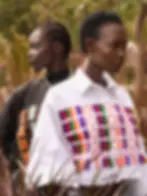
The traditional Fulani female outfit typically consists of a blouse worn with a wrapper. The base fabric is usually handwoven on a local loom and is most often white or off-white. Before embroidery begins, faint dashed lines—resembling running stitches—are sewn directly onto the cloth. These dashed lines usually run parallel across the surface and are commonly worked in red or black thread.
These guiding lines serve an important functional and aesthetic purpose. They provide alignment for the embroidery, making it easier to maintain symmetry and balance in the design. At the same time, they form a distinctive linear pattern that gives the base fabric its unique visual identity even before additional embroidery is applied.
Common Stitches Used in Fulani Embroidery
The most frequently used stitches in Fulani embroidery include:

Satin stitch
Herringbone stitch
Blanket (buttonhole) stitch
Couching stitch
Satin Stitch
The bold red, green, and blue blocks commonly seen on Fulani blouses are created using a laid satin stitch, also known as long-and-short filling laid in rows. In this technique, three-ply yarns are laid across the surface of the fabric rather than stitched directly through it. These laid threads are then secured with tiny couching stitches.
This method produces a raised, ribbed texture that gives the coloured rectangular motifs their strong visual impact. Satin stitch is frequently used on prominent areas such as the robe chest panel, sleeve bands, and decorative panels, where durability and visual emphasis are required.
Couching Stitch
Couching stitches are the small, nearly invisible stitches used to hold the longer laid threads in place. They are especially noticeable where:
Colours change
Curved or wave-like patterns bend
Threads are lightly tacked to maintain spacing
This technique allows artisans to use thick, brightly coloured yarns as embroidery threads, resulting in a bold, graphic appearance. Couching contributes significantly to the striking and tactile quality that makes Fulani embroidery visually attractive and highly distinctive.
Herringbone Stitch (Zigzag Grid)
The blue and red criss-cross motifs found between larger stitched blocks are worked using the herringbone stitch. This stitch creates diamond or star-like grid patterns across the fabric.
In Fulani embroidery, herringbone stitch is often used as a linking or spacing motif. It connects larger decorative elements while keeping the fabric flexible rather than stiff, allowing the garment to drape comfortably despite the density of the embroidery.
Blanket Stitch / Buttonhole Stitch (Green Edging)
The green stitches that frame the edges of Fulani blouses are worked using blanket stitch, also known as buttonhole stitch. This stitch creates a decorative border along the selvage and is commonly used around the neckline, armholes, and garment edges.
Beyond its decorative role, blanket stitch reinforces the fabric, preventing fraying and reducing strain caused by heavy embroidery. This finishing technique is widely found in Hausa and Fulani embroidery traditions and is especially important in traditional robes, where dense stitched panels could otherwise pull the cloth apart over time.
Materials
Traditionally, embroidery threads used in Fulani and related West African embroidery practices were locally spun cotton and silk. Metallic threads made from gold or silver were historically reserved for royalty, titled individuals, and ceremonial garments, signifying wealth, authority, and spiritual importance
In contemporary practice, embroiderers increasingly use imported, commercially produced 100% cotton embroidery threads such as Anchor and DMC, valued for their colourfastness, consistency, and durability. These are often used alongside locally produced ball threads, which are thicker, slightly lustrous, and well suited to bold geometric stitches. Among the most popular is Giraffe ball thread, widely favoured for its strength and vibrant colour range, making it ideal for high-contrast surface embroidery commonly seen in Fulani garments. Glitter or metallic-effect threads are occasionally incorporated to add shimmer and visual emphasis, particularly for festive or ceremonial attire.

Common base fabrics include 100% cotton Guinea brocade, handwoven damask, calico, adìrẹ (indigo-resist dyed cloth), and other locally sourced or woven textiles. These fabrics are chosen for their breathability, durability, and ability to support dense stitching without distortion. Moreover, the climate in northern regions can be extremely hot, making cotton fabrics especially suitable as they provide both the aesthetic appeal and the comfort required for everyday and ceremonial wears.
Methods
The embroidery process typically begins with sketching or lightly marking patterns directly onto the fabric using chalk, pencil, or washable markers. Designs are carefully planned to ensure balance, symmetry, and harmony with the garment’s structure. Once the layout is complete, the embroiderer traces the design with embroidery stitches, selecting colours that enhance contrast and bring clarity to the geometric motifs.
For women’s attire, embroidery functions primarily as surface decoration. It is most prominently worked around the neckline, chest, and front of the blouse, often extending downward in bold geometric arrangements. These designs are highly visible when women wear their blouses and wrappers, allowing the embroidery to serve as both adornment and a visual marker of cultural identity. The use of repeated geometric forms and open stitches ensures that the embroidery remains striking even from a distance, a feature particularly significant in communal and public settings.
Hausa Embroidery

Hausa embroidery is a highly developed textile art form from northern Nigeria, renowned for its precision, symbolism, and cultural significance. Hausa embroidery represents dignity, spirituality, and social identity. More than surface decoration, it functions as a visual language that communicates status, skill, and heritage.
The roots of Hausa embroidery can be traced back several centuries and were shaped by trans-Saharan trade, Islamic scholarship, and court culture. As Hausa city-states such as Kano, Katsina, Zaria, and Sokoto flourished as centres of commerce and learning, embroidery became an important marker of prestige. Royal courts and religious leaders commissioned finely embroidered garments made from hand-spun threads and locally woven cloth. Over time, distinct regional styles emerged, with Kano becoming particularly renowned for its master embroiderers.
Through trade, migration, and religious networks, Hausa embroidery spread beyond present-day Nigeria into Niger, Ghana, Chad, Cameroon, and Sudan. Today, the tradition has also gained international visibility through diasporic communities, museum collections, fashion showcases, and global textile fairs, positioning Hausa embroidery as a significant African embroidery tradition on the world stage.

Hausa embroidery is characterised by bold geometric patterns, linear compositions, and carefully balanced motifs. Unlike pictorial embroidery traditions, it emphasises symmetry and abstraction, often arranged around the neckline, chest, sleeves, and hems of garments. The style is deeply connected to Islamic aesthetics, favouring non-figurative designs that express order, rhythm, and harmony. Traditionally practised by men, embroidery was regarded as a respected professional skill passed down through apprenticeship.
Hausa embroidery is predominantly hand-stitched, using both counted-thread and freehand techniques. Designs are often drawn directly onto fabric before stitching, requiring a high level of precision and experience. Common stitches include:
Dagi (knot)
Kafe
Zargu
Ciko (filling)
Popular pattern styles (dinke / aska / surfani) include:
Wala-wala
Tsaiwa
Dagi
Rufin azara
Sawun kusu
Sarka
Bille
Gidan suga
In men’s garments, embroidery is strategically placed around collars, necklines, chest panels, pockets, sleeves, and sometimes along the front placket. These placements emphasize stature and formality, reinforcing the garment’s role in expressing masculinity, dignity, and social identity.
Stitches Used in Hausa Hand Embroidery
Hausa hand embroidery employs a wide range of stitches, including:
Decorative darning stitch
Running stitch
Seed stitch
Knotted stitches
Open chain stitch
Buttonhole stitch
Eyelets
Chain stitch
Satin stitch
Rosette button stitch
Decorative Darning Stitch
Decorative darning is an ornamental form of traditional darning, originally used to repair worn fabric. Threads are woven over and under the existing fabric threads in parallel rows, forming visible patterns such as checks, diamonds, waves, or blocks of colour. Beyond repair, decorative darning is used for visible mending, surface decoration, and symbolic storytelling in textiles.
Open Chain Stitch
Open chain stitch is a variation of chain stitch in which loops are spaced apart rather than touching. The result is a series of elongated, linked ovals that create light, rhythmic lines across the fabric.
Buttonhole Stitch
Buttonhole stitch is highly versatile and can be used as an edging, line, or filling. It creates a rope-like effect commonly used around necklines, collars, pockets, and decorative panels. Stitches may be worked closely together or spaced in pairs or threes. Tailors often charge extra for this stitch due to its labour-intensive nature.
Chain Stitch
Chain stitch is one of the oldest embroidery stitches, forming a series of connected loops resembling a chain. It is widely used for outlines and decorative lines in Hausa embroidery.
Knotted Stitches
Knotted stitches create textured, dotted effects, often clustered as French knots. They are commonly worked on floral cotton prints, adire, and Ankara fabrics, either in matching or contrasting colours to create rich, nubbly surfaces.
Satin Stitch
Satin stitch is a smooth filling stitch worked with closely packed parallel stitches. In Hausa embroidery, it is often surrounded by knotted stitches to enhance texture and visual depth.
Rosette Button Stitch
Rosette button stitch forms raised, circular motifs by working buttonhole stitches around a central point, creating a flower-like shape with strong texture and dimension.
Queen Amina Embroidery Initiative
Founded in 1994 in Zaria city, the Queen Amina Embroidery Initiative was established by a group of Hausa women under the guidance of Dr. Elisha P. Renne and named after the legendary Queen Amina of Zaria, also known as Amina of Zazzau, a sixteenth-century ruler whose reign marked a period of territorial expansion, economic growth, and cultural consolidation in northern Nigeria. The initiative focuses on preserving and promoting Hausa hand embroidery through the production of embroidered garments and household textiles, including babar riga, gowns, blouses, caps, bed linens, and decorative pieces.

The Queen Amina Embroiderers represent an important contemporary example of how traditional Hausa hand embroidery continues to be practiced, transmitted, and adapted in modern contexts. Through structured training, production, and public presentation, the initiative supports women artisans while maintaining techniques, motifs, and aesthetic principles rooted in Hausa embroidery traditions. Their work demonstrates the ongoing relevance of hand embroidery as both cultural heritage and skilled artisanal practice in northern Nigeria.
Renaissance
In recent decades, Hausa embroidery has experienced a cultural renaissance. Contemporary designers, historians, and craft advocates are reintroducing traditional patterns into modern fashion, blending heritage techniques with contemporary silhouettes. Increased interest in indigenous knowledge systems, alongside global appreciation for handmade textiles, has contributed to renewed respect for the craft. Workshops, exhibitions, and digital documentation now play an important role in preserving Hausa embroidery for future generations. In recent times, machine embroidery has increasingly replaced hand embroidery. Across Nigeria, men, women, and boys are commonly seen wearing large agbada robes, gowns, and other garments decorated with intricate machine-made embroidery. These embroidered designs, once created slowly and carefully by hand, are now produced more quickly and in large quantities using industrial and domestic embroidery machines.
While machine embroidery has made embellished garments more affordable and widely accessible, it has also contributed to the gradual decline of traditional hand embroidery skills. The speed and uniformity of machine work contrast sharply with the individuality, symbolism, and cultural knowledge embedded in hand-embroidered motifs. Nevertheless, machine embroidery continues to shape contemporary Nigerian fashion, blending modern technology with long-established aesthetic traditions.
Conclusion
Hausa embroidery is far more than surface decoration; it is a living archive of history, belief systems, social identity, and highly skilled labour passed down through generations. Each stitched motif carries meanings connected to status, spirituality, protection, and community belonging, making the practice an essential form of visual language within Hausa culture. Through clothing and household textiles, embroidery has long served as a marker of dignity, craftsmanship, and cultural continuity.
In the contemporary era, Hausa embroidery stands at a critical crossroads. While machine embroidery has transformed production processes and expanded access to embellished garments, it has also contributed to the erosion of hand-embroidery knowledge, patience-based skill, and symbolic literacy embedded in traditional techniques. The growing dominance of speed and uniformity risks flattening the individuality and cultural depth that distinguish hand embroidery from its mechanised counterpart.
Yet, the current renaissance offers renewed hope. The efforts of artisans, designers, scholars, museums, and community-led initiatives are helping to document, teach, and reinterpret Hausa embroidery for new contexts. By integrating traditional techniques into contemporary fashion, education, and heritage preservation programmes, practitioners are ensuring that the craft remains relevant rather than static. Digital platforms, exhibitions, and international collaborations further extend its reach, positioning Hausa embroidery as both a local cultural practice and a global textile heritage.
Preserving Hausa embroidery requires intentional support—through training, fair compensation for artisans, intergenerational knowledge transfer, and recognition of hand embroidery as both cultural heritage and viable livelihood. When valued not only as fashion but as embodied knowledge and cultural expression, Hausa embroidery can continue to thrive, inspiring future generations while maintaining its deep roots in history and identity.
Hausa embroidery is more than decoration; it is a living archive of history, belief, identity, and skilled labour. Preserving and supporting this tradition ensures that its knowledge, aesthetics, and cultural value continue to inspire future generations.
Diallo, Y. (2012). Fulani aesthetics and material culture. In Sahelian visual traditions. Dakar: CODESRIA.
Krätli, S., & Schareika, N. (2010). Living off uncertainty: The intelligent animal production of dryland pastoralists. European Journal of Development Research.
National Commission for Museums and Monuments (Nigeria). (n.d.). Traditional Nigerian arts and crafts.
Nkwi, W. G. (2014). Toghu and the cultural identity of the Cameroon Grassfields. Bamenda: Langaa RPCIG.
Perani, J. M., & Wolff, N. H. (1999). Cloth, dress, and art patronage in Africa. Oxford: Berg.
Picton, J., & Mack, J. (1989). African textiles. London: British Museum Press.
Provides foundational analysis of West African textile traditions, including embroidery and symbolism.
Renne, E. P. (2010). The changing politics of fashion in Northern Nigeria. Bloomington: Indiana University Press.
Renne, E. P. (2013). Clothing and difference: Embodied identities in colonial and post-colonial Africa. Durham: Duke University Press.
Rovine, V. (2009). African fashion, global style: Histories, innovations, and ideas you can wear. Bloomington: Indiana University Press.
Contextualises traditional embroidery within contemporary and historical African dress practices.
Spring, C., & Hudson, J. (1995). North African textiles. London: British Museum Press.
Useful for understanding embroidery traditions across pastoral and trans-Sahelian cultures.
UNESCO. (2017). Cultural heritage and traditional craftsmanship in Northern Nigeria.
Online Sources
African Journals Online (AJOL). (n.d.). Design Perspectives article.
https://acjol.org/index.php/designperspectives/article/view/6659/6447
IIARD Journals. (2025). Empowering tradition, enriching communities (pp. 78–83).
Textile Research Centre, Leiden. (n.d.). The Queen Amina embroideries from Nigeria.
https://www.trc-leiden.nl/trc/index.php/en/blog/786-the-queen-amina-embroideries-from-nigeria
ZODML. (n.d.). Art: Hausa embroidery.
https://zodml.org/discover-nigeria/heritage-and-culture/art-hausa-embroidery