

Kyrgyzstan
Author: Nazira Juman Chaa Translated by: Marina Oks
Kyrgyz Embroidery. A History Woven into the Thread.
Here you can find lots of interesting facts from the history, symbolism and techniques of Kyrgyz embroidery, a unique art which preserved the spirit of nomadic culture and women’s craftsmanship.
Dear reader, welcome to the country of Heavenly Mountains. To help you understand where it’s located, I can give you a hint. Kyrgyz Embroidery. A History Woven into the Thread.
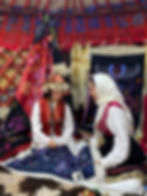
Here you can find lots of interesting facts from the history, symbolism and techniques of Kyrgyz embroidery, a unique art which preserved the spirit of nomadic culture and women’s craftsmanship.
It’s a mountain range that begins at the Ural range, stretches into the Kyrgyz Ridge, then spreads out into the Tian Shan before finally rising to meet the chain of the Himalayas.
Similar to this mountain ridge, stretches the thread of the national Kyrgyz embroidery, which goes back a few thousand years. You are most probably familiar with the classical principles of European embroidery, but you most likely know little about the native, inherently natural essence of Kyrgyz embroidery, deep-rooted in the national culture. However, I might as well be wrong.
One of the living native examples that has survived to the present day I consider a wall-piece - tush kiyiz*. It’s not only a decorative element, but, as I told you last time, an example of semantic writing, embroidered on canvas. Its history goes back to ancient times, and through its embroidered motifs, one can trace a family’s history, lineage, and its inherent traits. Although traditionally, tush kiyiz was embroidered as a girl’s dowry, there were also gift wall pieces for newborn babies, parents, and other near and dear ones.
When looking at the ancient tush kiyiz, I see far more than just a decorative object. I see history — the history of nomadic people, where each thread tells a story of the past. For us, embroidery is more than just ornamentation. It’s our memory which we pass down from generation to generation, from mother to daughter. From early childhood, I remember our family gatherings, and my grannies (apashki*) showing me how to make the first stitches. It felt like a sacred ritual. For me, an eight-year-old city girl, it was a sort of magic. I painfully pricked my fingers striving to find the right rhythm. In fact, I was learning to cross stitch. It was in the mid 70-s of the XX century. The classical embroidery of ildemos* was far too intricate for a child’s mind—more precisely, I simply could not grasp it.
The arch of tush kiyiz was embroidered on some thick fabric. It was usually felt, fleece, but most often velvet, silk, plush, brocade, and even leather.
Just like duruya zhooluk*, tush kiyiz is a program product: together with the semantic writing about the family’s lineage, it contains sacred meanings with the wishes of welfare, health and strength. These are most often ornamental motifs. In these patterns, I sense echoes of towering mountains, verdant pastures, and the boundless sky. Each motif is more than just a line, it’s a symbol. Looking at tush kiyiz, I feel connected to my ancestors, their strength and wisdom.
Apart from ilmedos, the Kyrgys can also boast of other kinds of embroidery, such as
Tepchime (stitching that follows the contours of the pattern);
Kaiyp tiguu (diagonal stitches);
Tordoo (overcast stitch around, or simply following, the contours of the pattern);
Kerme (chain);
Tekeche (goat stitch);
Kyima (cross stich);
Ilme (very similar to ilmedos);
Mushkul (like tepchime is used in contour embroidery);
Terskaiyk (herringbone stitch);
Basma (satin stitch).
The most archaic kind, similar to terskaiyk and having no name (at least no name has been preserved) is the tambour stitch.
Heritage in each stitch

Today, I see our traditional art gaining wider popularity. Young people around the world are taking an interest in embroidery, which fills me with joy. I know that every piece of embroidery—whether it is clothing or a wall decoration—carries the spirit of the Kyrgyz people. It embodies our history and culture, and it will endure for generations to come.
The XXI century has witnessed a renaissance of Kyrgyz embroidery. Growing interest in ethnic styles, support from cultural organizations, and the expansion of artisan communities have all contributed to the popularity of traditional techniques. Modern designers integrate embroidery in the latest fashions, interiors, accessories, while striving to preserve its authenticity.
Export is also expanding: items with Kyrgyz embroidery, such as clothing, bags, wall pieces, decorative elements, are in demand abroad. Educative master classes and on-line schools help pass down the traditions to the new generations. However, without continuous support for local artisans, there remains a risk of losing these unique regional techniques.
For Kyrgyz artisans, embroidery is not just a hobby, but a link with the past and hope for the future.
Let’s get back to the main subject of our article - ilmedos* embroidery. It’s one of the most widespread kinds of embroidery characteristic of the Kyrgyz people. The word ‘ilme’ means ‘a loop’. In this embroidery, they use a tool which looks like a small awl. The word combination ilmedos is translated as ‘a friends of the loop’, meaning a small awl used for making these loops.
Ilmedos is a type of loop stitch. Artisans create loops by throwing the thread to the left and passing the needle through the center of the previous loop. On the front side, this forms a chain of loops, while on the back side it creates a continuous line of stitches.
Artisans follow a pre-marked outline, which allows them to create any circular lines and curved contours of the pattern. This gives the embroidery a distinctive aesthetic and artistic expression.
The distinctive feature of ilmedos is that the looped threads cover the entire width of the motif, filling it densely. This gives the embroidery volume and expressiveness.
Often, several rows of loops are used in this technique—especially with lighter threads—which adds an extra decorative richness to the pattern.
It was previously believed that ilmedos embroidery was most characteristic of the southern Kyrgyz: it was widely used in traditional embroidery and can still be seen in contemporary works. This distinguished their embroidery from the traditions of northern Kyrgyz, who in the past mainly used this stitch in appliqué. However, there appear to be some historical inaccuracies here, likely connected to the erasure and distortion of authentic cultural facts. In any case, this is not our topic—we’ll leave it to the politicians.
The antiquity of this stitch is confirmed by findings at the Kara-Bulak burial site in the Batken region, which date back to the early centuries CE. Unfortunately, these artifacts are currently under restoration and are not accessible to the general public.
While the main motifs and techniques remain consistent throughout Kyrgyzstan, regional differences are expressed through the color palette, density of ornamentation, and style of work.

Southern regions (Osh, Batken, Jalal-Abad): bright colors, a variety of techniques, intricate ornamental composition. They used combined embroidery with glass seed beads and cords.
Northern regions (Chuy, Issyk-Kul): more reserved colors, simplified shapes, geometric motifs, often in combination with felt appliqués.
These differences are due to natural climatic conditions as well as cultural contacts with neighboring peoples - Uzbeks, Tajiks, and Kazakhs.
Ilmedos was used to ornament various household objects and clothes.
Tush-kiyizy: wall decorative pieces.

Textile goods: bed covers, table cloths, yurt elements.

Clothing: women’s dresses, headware, men’s trousers.
Ilmedos is not just a kind of stitch, but a striking example of how folk craftsmanship embodies a people’s cultural identity and historical heritage.
Ilme style features loops of different size: bigger and smaller ones. The Kyrgyz word for embroidery is saima, which can be translated as ‘set, lay’, while the technique of smaller stitches has its peculiarities: the smallest stitches made with an awl are called syrke saima, “embroidery the size of a flea egg”. Its peculiarity is its size and density.
Embroidered elements of national women’s headwear kep takyya, which is worn under other headwear: elechek*, duruya zhooluk and tebetey*. Syrke saima style is unique to the Kyrgyz embroidery, making it different from other styles and even countries. It requires a remarkable skill and, due to its density, resembles a woven fabric. In Kazakhstan, Uzbekistan, and Tajikistan, you are unlikely to encounter this type of embroidery, while in Kyrgyzstan only a few artisans possess this skill. This piece was created by an artisan from the Naryn region of Kyrgyzstan, Ibarat Amangeldiev. He is currently the only artisan in the country working in the syrke saima technique. His works are highly valued by ethnographers.

It’s remarkable that a man mastered this technique. Female embroiderers are quite few, but the art of small stitch, syrke saima, is truly unique, I have not come across any other works in this technique, except the works by Ibarat Amangeldiev, in any of the seven regions of our country. You can follow these links and see how skillfully he mastered the ilmedos technique:
Next time we will look into other kinds of traditional embroidery techniques in Kyrgyzstan, and will be able to discover the native beauty of national art, feel the energy and mesmerizing aesthetic of handmade work.
Glossary:
Kep takyya is a traditional Kyrgyz women’s hat, usually worn under an elechek (a kind of headwear) or some other kind of headwear. It’s not common to wear a kep takyya on its own. It’s considered to be a quite intimate article of headwear and can only be taken off in the presence of family members. It was considered bad manners to wear a kep takyya in public. It’s decorated with embroidery, beads, cord, and other decorative elements. It’s more than just a decoration, it reflects the age, family and social status of a woman.
An interesting fact: young girls can have colorful and richly decorated kep takyya, while older women wear more reserved ones.
Elechek is long white fabric that a woman wraps in a special manner around her head. It’s one of the main elements of Kyrgyz national women’s costume. Elechek symbolizes purity, respect, and maturity. Its shape and the way of wrapping may vary depending on the region, age and family status.
An interesting fact: an elechek worn by a young woman is compact, while senior women wear a more voluminous and intricately shaped.
Beldemchi is a traditional wrap-around skirt that is tied over a dress or skirt. It is often made of thick fabric and decorated with embroidery, patterns, ribbons, or fringe. A beldemchi serves both decorative and practical purposes — it protects the clothing and shields the lower back and legs during horseback riding.
An interesting fact: a beldemchi often features symbols of fertility, wellbeing, and protection.
Resources
Antipkina K.I. Peculiarities of the Material Culture and Applied Arts of the Southern Kyrgyz. Based on Materials Collected in the Southern Part of the Osh Region of the Kyrgyz SSR. — Frunze, 1962.
Malchik A. Yu. History of Kyrgyz Folk Applied Art: The Evolution of Kyrgyz Ornament from Antiquity to the 20th Century. — Bishkek, 2009