

Toghu Embroidery
Contents

Source: faghasdesigns.com

My curiosity about Toghu embroidery deepened during my visit to Cameroon in 2024. One evening, while riding back to my hotel on a motorcycle, I noticed rows of velvet garments—men’s, women’s, and children’s pieces—displayed along the roadside. Their bright, intricate embroidery immediately caught my attention. Fascinated by the vivid colours and expert craftsmanship, I began asking questions. Almost every Cameroonian I spoke with owned at least one Toghu outfit, which revealed its deep cultural significance and its seamless integration into both everyday and ceremonial life.
During a recent conversation with my sister-in-law in the United States, she mentioned attending a gathering where her Cameroonian friends wore their traditional attire. Curious to learn more, I asked her to share photos—and there they were: beautifully dressed in stunning Toghu garments.
About
Toghu embroidery, also called Atoghu, is one of Cameroon’s most iconic textile traditions. Known for its deep black velvet base adorned with bold, colourful embroidery, Toghu has evolved from royal regalia into a powerful symbol of identity, heritage, and contemporary fashion. Toghu cloth is primarily associated with people from the North West and West regions; sanja (loincloth) and shirts are linked to communities in the South West region; and aqwada or gowndorra garments are commonly worn among the Hausa and Fulani groups of Northern Cameroon.
History

Bamenda is a wetland region in Cameroon. It is also called Mazam, Abakwa, or Mankon Town. According to history, Toghu dates back to around 1919. It was introduced by a Portuguese trader. The cloth originally had 63 motifs. The people of Mankon selected some of these motifs and used them to create the Mankon “Toghu,” which is now their traditional wear.
In the past, Toghu was not very common because its embroidery was reserved for royals and priests during special rituals and ceremonies. Historically, Toghu was reserved for kings, queens, nobles, warriors, and dignitaries. It symbolized authority, prestige, and spiritual protection. Motifs communicated ancestral lineage, social hierarchy, and cosmological beliefs.
Toghu originates primarily from the Grassfields region of Cameroon—especially among the Bamileke, Bamenda, Banso, and related communities of the Northwest. Though often associated with Cameroon’s northern regions, Toghu motifs are used widely to distinguish rulers from their subjects and to denote status within local communities.
Toghu garments were first made with imported materials, but over time, communities in the Grassfield areas—especially the Northwest region of Cameroon—developed their own unique embroidery styles. This helped give Toghu its distinct and indigenous identity.
Traditionally stitched with vivid acrylic yarns in yellow, green, red, and white, the motifs are first hand-marked with chalk before being embroidered by hand or machine.
Most motifs on Toghu garments represent symbols tied to royalty, wealth, messages from ancestors, and the nobility class system. While documented explanations of specific motifs are limited, oral histories emphasise their deep cultural meaning. Some modern designers and scholars note that information about the significance of certain motifs is scarce—an indication of how much of this heritage remains undocumented.
Spread to Other Countries
Diaspora communities have carried Toghu to Europe, the U.S., Nigeria, and South Africa, where it features prominently in weddings, cultural days, and African-inspired events. Designers across Africa now integrate Toghu-inspired motifs into jackets, formalwear, accessories, and children’s clothing.
Techniques

Traditional Toghu embroidery relies on hand-stitched chain work and couching techniques applied on heavy velvet or cotton. Patterns are drawn with chalk, and artisans often work in teams due to the fabric’s thickness and the complexity of designs. The process requires immense skill, patience, and cultural knowledge. While black or blue velvet is traditional, modern makers may also use cotton or silk.
Type of Stitches
Common Stitches in Toghu Embroidery
Toghu embroidery features a distinctive combination of traditional African hand-stitching techniques and decorative methods adapted to velvet and cotton fabrics. Below is an expanded, alphabetically arranged list of the most common stitches used in Toghu, followed by a consolidated reference section.

Arrowhead Stitch (Tiger Teeth Design)
The Arrowhead Stitch known locally as the “Tiger Teeth Design” — is a hallmark of Toghu embroidery. It consists of repeated V-shaped stitches arranged in rows, often forming triangular patterns along hems, cuffs, borders, and neckline decorations.
Artisans commonly alternate bright colours such as red, yellow, green, and white to create the sharp, tooth-like visual effect. This stitch is one of the most instantly recognizable motifs in Toghu garments. It can be done in cone shapes, spaced singularly or joined together.
Backstitch
The Backstitch is used primarily for outlining motifs with accuracy and strength. In Toghu, machine embroiderers frequently employ this stitch to define borders and strengthen outlines, while hand embroiderers use it to secure shapes before filling with chain or satin stitches.
Its durability makes it suitable for dense fabrics such as velvet.
Blanket Stitch / Buttonhole Stitch
This stitch produces a rope-like, decorative edge that enhances the finish of Toghu garments. It is commonly used along selvedges, sleeves, and hems to secure edges and prevent fraying.
Bright red or yellow yarns are typically used, contributing to Toghu’s bold, colourful aesthetic.
Cable Stitch
The Cable Stitch creates raised, textured lines and braided effects. It is used to add depth, outline central motifs, or build geometric patterns.
Because of its complexity and time-intensive nature, the cable stitch is more often seen in premium hand-embroidered Toghu.
Chain Stitch
The Chain Stitch is central to Toghu embroidery and is used to create curved lines, spirals, and flowing designs. It forms the basis of many motifs and is executed by both hand and machine artisans.
Hand-stitched chain work tends to have slight variations, while machine chain stitch appears uniform and tightly spaced.
Couching
Couching is employed when bold, raised motifs are needed. A thicker yarn is laid across the fabric’s surface and tacked down with smaller stitches.
This technique is ideal for creating dramatic spirals, medallions, and royal symbols that must stand out prominently against the black velvet background.
Satin Stitch
The Satin Stitch is used to fill enclosed shapes with smooth, solid colour. It is commonly used for leaves, flowers, circles, sunburst motifs, and other symbolic elements.
On velvet, satin stitch requires careful tension control to maintain smoothness and avoid puckering.

Machine Embroidery
Machine embroidery produces clean, uniform stitches ideal for commercial production. You can identify machine-made Toghu by its perfectly even stitch lengths and the mechanical precision of repeated motifs. Hand-embroidered Toghu, on the other hand, shows slight variations that give it character, cultural authenticity, and a sense of the maker’s touch.
Most Toghu garments seen in markets and shops today are machine-embroidered, allowing for greater output in shorter production time. The widespread availability of computerized embroidery machines has also made it easier to replicate traditional motifs on a larger scale.
Types of Embroidery Machines Used for Toghu
Computerized (Digital) Embroidery Machines
The most common for modern Toghu production.
Use programmed designs loaded through USB or software.
Capable of producing highly detailed patterns with multiple thread colours.
Ideal for mass production and consistent repetition of motifs.
Multi-Needle Industrial Embroidery Machines
Often used in small factories or professional workshops.
Contain 6–12 (sometimes up to 15) needles, each pre-threaded with different colours.
Fast, efficient, and suitable for bulky fabrics like velvet—the preferred base for Toghu.
Single-Head, Single-Needle Machines
Used by small businesses or individual tailors.
More affordable and easier to maintain.
Slower than multi-needle machines, but still offers precision for detailed motifs.
Sewing Machines with Embroidery Attachments
Less common for Toghu because the fabric is thick.
Used mostly for experimental or small-scale designs.
Preparation Steps for Machine Embroidering Toghu
Fabric Selection
Velvet is the traditional choice; high-pile or medium-pile velvet is preferred. This is predominantly in black and royal or navy blue colour.
The fabric must be inspected for faults, lint, and pile direction.
Stabilizing the Fabric
A stabilizer (backing) is attached to the underside to prevent stretching or puckering.
For Toghu, heavy-duty cut-away stabilizer is recommended due to the dense stitches.
Some workshops also add a water-soluble topping on the velvet surface to prevent the pile from swallowing the stitches.
Design Digitization
Traditional Toghu motifs—spirals, stars, geometric lines—are converted into digital stitch files.
Designers adjust stitch density to suit thick velvet; too much density leads to thread breakage.
Threading and Colour Setup
Classic Toghu colours (yellow, red, green, white, black) are threaded into the machine.
Multi-needle machines allow seamless switching between colours.
Test Stitching
A sample is tested on scrap velvet to check tension, density, and clarity.
Necessary to avoid wastage on the main fabric.
Embroidery Process
The machine follows the programmed sequence.
Operators monitor thread tension, thread breakage, and fabric movement.
Finishing
Excess stabilizer is trimmed from the back. The surface pile is brushed to restore velvet texture. Loose threads are removed, and the garment is pressed lightly from the wrong side.
Common embroidery machine for use is locally called “ tinko embroidery machine.
Each motifs have cultural symbol and meaning.
Common Motifs
Hand-sketched elements include:
Spirals
Leaves
Geometric borders
Animal or symbolic figures (e.g., spiders symbolising wisdom)
Style of Patterns

Toghu motifs are bold, geometric, and symbolically expressive. Common motifs include:
Spirals and concentric circles to include alphabets and numbers.
Zigzags symbolising resilience or strength
Floral and leaf designs
Sun-like medallions, e.g full moon,
Royal emblems such as shields, spears, and crowns
Animal designs like lizards, snakes, crabs, fish, crocodiles, elephants, scorpions, and more.
Each motif carries cultural or spiritual meaning.
Materials & Tools
Medium to large embroidery needles
Frames or hoops (optional; many artisans stitch without them)
Scissors
Pattern templates (common in modern production)
Chalk for markings
Embroidery machines
Heavy velvet or cotton fabrics
Bright acrylic yarns (red, yellow, green, white)
Backing fabric for stability
As with all embroidery, materials matter. Thread choice must match fabric weight to ensure even stitching. Hand-sewing needles for Toghu must have eyes wide enough to accommodate acrylic yarn.
While black velvet is most common, similar velvet fabrics are worn across Nigeria and other parts of West and Central Africa.
Globally, embroidery threads range from six-strand floss to pearl cotton, linen thread, filo floss, tapestry wool, Persian wool, and more. Toghu embroidery uses size 2 acrylic yarn—a 3-ply yarn resembling tapestry wool. These yarns are produced in Lagos and Kano, Nigeria, and shipped to Cameroon. Beyond Toghu, they are widely used for knitting, crochet, weaving, and hair plaiting across West Africa. Their vibrant colours represent prosperity, fertility, unity, and cultural vibrance.
On closer observation, the embroidery is not as bright as what we see today, which helps explain the type of yarn used. Earlier Toghu embroidery often used natural fibers or imported materials that produced softer, less vivid colours.
Although Cameroon has some local textile activity, there is currently limited large-scale production of brightly dyed embroidery yarns, especially acrylic yarns. As a result, many contemporary textile materials used for Toghu embroidery are imported, including supplies sourced through regional trade, particularly from Nigeria, as well as from wider international markets.
This reliance on imported, brightly dyed acrylic yarns explains why modern Toghu designs appear more sharply defined and vibrant, whether they are machine-embroidered or hand-marked.
Now a Days
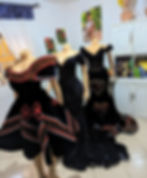
In recent years, Toghu has undergone a remarkable revival. Cameroonian designers, diaspora communities, and cultural organizations have promoted it through festivals, pageants, fashion shows, heritage conferences, and Pan-African events.
Contemporary designers—such as Ultimate Design and other emerging creatives—have brought Toghu embroidery into haute couture, red-carpet fashion, and global African design narratives.
Today, Toghu appears on:
Dresses, gowns, and men’s suits
Handbags, footwear, and accessories
Home décor and upholstery
Machine-embroidered digital products
Appliqué work
Print designs on wrappers, earrings, and more
Despite the rise of machine embroidery, hand-stitched Toghu remains the gold standard for authenticity and cultural value. Contemporary designs for men often feature a long, typically oversized gown paired with a wrapper tied in two different lengths, depending on the overall design. This style is commonly referred to as a gandoura or gandola. It is traditionally worn with a cap, a bag carried on the left side, and a walking stick in the right hand, which may be either long or short. In recent times, Toghu embroidery markings have shown stylistic similarities to some traditional Igbo outfits in Nigeria. This reflects a blending of cultural elements between Cameroonians and Nigerians, highlighting a shared heritage and mutual influences common among neighbouring communities.
Cameroonian women are highly fashion-conscious and invest deeply in their appearance, including wearing Toghu embroidery in all its variations. In fact, to be taken seriously as a guest, speaker, or visitor, one must make an extra effort to dress in native attire. I personally had to change my outfit twice before I was allowed to speak at HIBMAT University!
Conclusion
Conclusion of Initial Survey
A small but insightful survey of 11 Cameroonians that I sampled revealed diverse connections to Toghu:
40% were very familiar; others had partial or limited knowledge.
Only a few actively wear or make Toghu, yet 70% expressed strong interest regardless of personal ties.
Perceptions of authentic materials varied between velvet, cotton, and silk.
Essential colours identified included white, red, yellow/gold, green, black, and occasionally blue.
40% believed the colours hold symbolic meaning linked to ancestry.
Respondents emphasized the creativity, uniqueness, and cultural depth of hand embroidery.
Some shared motif meanings—such as the spider, symbolising unity and protection.
Many agreed Toghu continues to reflect Cameroon’s cultural identity even as new interpretations emerge.
One respondent summarized it best:
“Each stitch tells a story and is linked to our ancestral origin.”
References
Anyakoha, E. Textiles and Embroidery in West Africa. 2015.
Ayuk, B. “Embroidery Practices in Bamenda.” African Textile Journal, 2018.
Bitor, Christopher, and Aliyu. [Title of Paper Unknown]. Academia.edu. https://www.academia.edu/38180223/BITOR_AND_ALIYU_1_
Cole, R. Decorative Stitches: A Global Perspective. 2010.
Hall, Dorothea. Needlecraft Workstation. London: Blitz Editions, n.d.
Hillmorton, Theresa de. The Complete Encyclopedia of Needlework. 3rd ed. n.p.: n.p., n.d.
Moungande, Bikmé. Dress and Subculture Identification in Cameroon. n.p., n.d. https://ceforpat.com/wp-content/uploads/2022/08/Dress-and-subculture-identification-in-Cameroon_Moungande_Bikme.pdf
Neba, V. “Yarn and Thread Traditions in Grassfields Culture.” West African Crafts Review, 2017.
Nkongho, L. “Symbolism in Grassfields Royal Regalia.” Journal of Cameroonian Cultural Studies, 2021.
SCIRP. [Article Title Unknown]. https://www.scirp.org/pdf/adr_2023053013504545.pdf
The Harmony Guide to Decorative Needlecraft. Edited by Kit Ayman and Carol Edwards. n.p.: n.p., n.d.
The Colorful Cloth. “Toghu Fabric.” The Colorful Cloth. https://www.thecolorfulcloth.com/search/label/Toghu%20Fabric
Ultimate Traditional Designs. “What Is Toghu?” Ultimate Traditional Designs. https://ultimatetraditionaldesigns.com/what-is-toghu/